beehiiv vs Substack
This is the comparison most people actually mean when they ask which newsletter platform to use, and it is the one where the answer changes as you grow. Substack charges nothing up front and 10% of paid subscription revenue forever. beehiiv charges a flat monthly fee and takes 0%. Everything else is detail on top of that single trade.
The useful question is not which is cheaper, it is where the lines cross.
Affiliate disclosure: we may earn a commission if you subscribe through our links, at no extra cost to you.
The short answer
Substack is cheaper until your paid subscriptions pass roughly $430 a month. After that its 10% cut costs more than beehiiv Scale, and it keeps costing more every month you grow.
Side by side
| beehiiv | Substack | |
|---|---|---|
| Cost to start | Free to 2,500 subscribers, then $43/mo | Free, no monthly fee ever |
| Cut of paid subscriptions | 0% | 10%, plus Stripe fees |
| Ad and sponsor network | Built in, matches sponsors to your list | None. You sell your own |
| Other revenue | Digital products, boosts, paid tiers | Paid subscriptions only |
| Custom domain | Included | One-off fee |
| Design control | Full website builder and themes | Limited, deliberately uniform |
| Built-in discovery | Recommendation network and boosts | Notes, app and network effects |
| Automations | Yes on paid plans | Welcome email only |
List prices checked September 2026. Both platforms change their plans, so confirm on their own pricing pages before committing.
The crossover point, in actual numbers
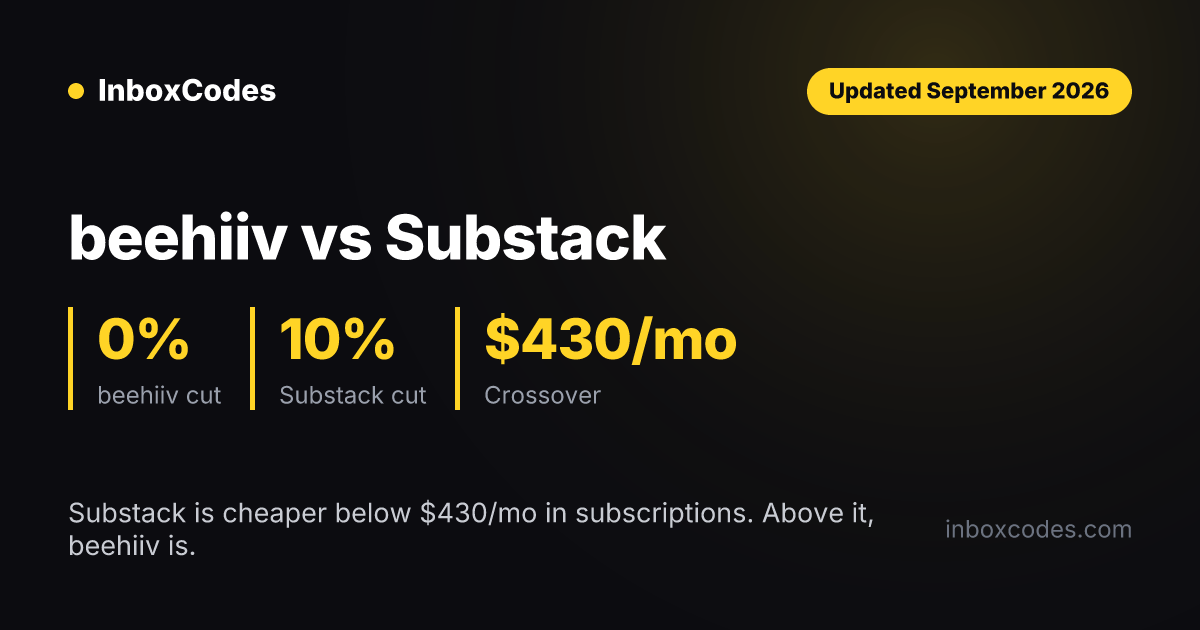
Substack takes 10% of paid subscription revenue. beehiiv Scale is $43 a month flat. Set those equal and the crossover is $430 a month in subscription revenue: below it Substack is cheaper, above it beehiiv is.
At a typical $10 a month subscription, $430 is about 43 paying subscribers. That is a small number for anyone running a newsletter seriously. If you have 200 paying subscribers at $10, Substack takes $2,000 a year while beehiiv takes $516, and the gap widens every subscriber you add.
The counterpoint is real though: if you have zero paying subscribers, Substack costs zero and beehiiv costs $516 a year. Plenty of newsletters never turn on payments, and for those Substack is unambiguously the right call. Do not pay for monetisation tooling you have no plan to use.
What Substack genuinely does better
Substack has network effects that beehiiv cannot replicate by building features. Notes, the app, and reader recommendations put new writers in front of an existing audience of readers who are already in the habit of subscribing to things. For a writer starting from nothing with no distribution of their own, that is worth a great deal.
It is also simply easier. There is almost nothing to configure. You write, you press send. The deliberate lack of options is a feature if options are the thing stopping you from publishing.
And the brand carries weight with readers. Some audiences trust a Substack link in a way they do not yet trust an unfamiliar newsletter domain.
Where Substack starts to hurt
The 10% never goes away, and it applies to revenue rather than profit. As your newsletter becomes a business, it starts to read like a partner who does progressively less for a progressively larger cheque.
Paid subscriptions are also the only lever. If your newsletter is better suited to sponsorship than to a paywall, and most niche B2B newsletters are, Substack gives you no infrastructure for it. You are finding advertisers, negotiating, invoicing and chasing payment yourself.
Customisation is thin by design, so your publication looks like every other publication. That is fine for a personal essay newsletter and a problem for anything trying to look like a media property.
Moving from Substack to beehiiv
Free subscribers are easy. Substack exports a CSV and beehiiv imports it, and beehiiv can also mirror your archive so your posts and their URLs come across.
Paid subscribers are the fiddly part, because you are moving recurring billing between Stripe accounts. beehiiv has a migration path for this and will help on the larger plans, but it is a job to plan rather than to attempt on a whim. Do it at a calm point in your publishing schedule, not the week of a launch.
So which one?
Pick beehiiv if
- You already have, or expect, more than about 43 paying subscribers
- You want sponsorship revenue as well as subscriptions
- You want the publication to look like your brand rather than a Substack
- You want referral and recommendation growth you control
20OFF202614 days free, then 20% off your first 3 months. About $34.40/mo for Scale.
Pick Substack if
- You have no paid tier and no near-term plan for one
- You want to publish today with nothing to configure
- Substack Notes and the app are a meaningful source of your readers
- A flat monthly bill before any revenue would genuinely put you off publishing
We earn nothing if you choose Substack, and it is still the right answer for plenty of people. A recommendation you cannot trust is worth nothing to either of us.
beehiiv vs Substack questions
Is beehiiv cheaper than Substack?
Can I move my Substack subscribers to beehiiv?
Does Substack have a promo code?
Will I lose my Substack readers if I move?
Other comparisons
beehiiv vs Kit (ConvertKit)
These are different categories of tool. Kit is email marketing that a newsletter can live inside. beehiiv is a...
beehiiv vs Ghost
Ghost is the ownership play and beehiiv is the distribution play. Ghost gives you the whole stack and no reven...
All four side by side
The full table: beehiiv, Substack, Kit and Ghost in one view.
Use 20OFF2026 at beehiiv checkout
14 days free, then 20% off your first 3 months on Scale and Max. Verified October 2026.
20OFF2026Affiliate link. We may earn a commission if you subscribe, at no extra cost to you.